

How to Choose an LED Strip
To ensure the most suitable lighting, its durability, and energy efficiency, it is very important to choose the right LED strip. LEMONA electronics experts have created this simple guide that answers the most frequently asked questions and clearly reviews all the key criteria related to LED lighting that you should consider when selecting LED lighting for your home or commercial premises.

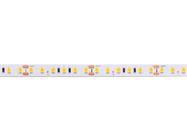




5 Key Questions to Answer When Choosing LED Strips
1. What Will Be the Purpose of the LED Lighting?
- Decorative lighting – Lower brightness LED strips (e.g., 300–600 lm/m) are suitable for niches, furniture, and display cabinets.
- Main lighting – Higher brightness LED strips (e.g., 1200–3000 lm/m) can be used as the primary light source in a room.
- Outdoor lighting – It is necessary to choose waterproof LED strips (IP65 or higher).
3. What Light Color and Color Temperature Are Suitable for My Room?
- Warm white (2700–3000 K) – Cozy and comfortable, ideal for home environments.
- Neutral white (4000–4500 K) – Similar to natural daylight, suitable for work areas.
- Cool white (5000–6500 K) – Bright and crisp, ideal for technical and commercial spaces.
- RGB/RGBW – Colored lighting that allows you to change and customize colors.
4. Should I Consider the LED Power Supply Voltage?
- 12 V – Most commonly used for shorter segments; easier to adapt and install.
- 24 V – A better choice for longer strips, ensuring a more stable light output.
- 48 V – Very low voltage drop, suitable for connecting long LED strip runs, allowing up to 15 m to be powered from one end.
5. Do I Need a High-Protection (IP-Rated) LED Strip?
- IP20 – For indoor use in dry environments with little moisture.
- IP44 – Moisture-resistant, suitable for bathrooms and kitchens.
- IP65/IP67 – Highly water-resistant, suitable for outdoor use.
Next Step: Choosing a Power Supply for LED Strips
The power supply is one of the key components of a lighting system, as it directly affects the quality of the lighting and the reliability of the system’s operation. So how do you choose the right one from the many options available on the market?
Choosing a Power Supply Based on Power Output
The power of the power supply is calculated by multiplying the strip length (in meters) by the strip’s power (W/m), and then adding at least a 15–20% reserve.
For example, if you have a 5 m LED strip with a power rating of 9.6 W/m, the calculation would be:
9.6 × 5 = 48 W
Although power supplies can operate at 100% load, it is not always possible to ensure proper cooling of the housing. Therefore, it is recommended to choose a power supply with at least a 20% power reserve:
48 W × 1.2 = 57.6 W
So, the recommended power supply in this case would be at least 57.6 W (typically rounded up to the next available standard power rating).
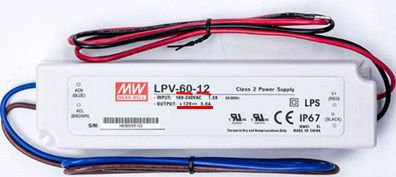
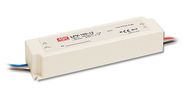
Fig. No. 1 The power of a power supply is often indicated by the first number appearing after the series name, while the second number shows the output voltage. Most power supplies manufactured by MEAN WELL are labeled this way. More detailed information can always be found in the product’s technical specification.
The power supply shown in the image has a power rating of 60 W, an output voltage of 12 V, and a maximum output current of 5 A. This is a constant voltage power supply, suitable for powering LED strips or LED modules.
Which Is Better: Constant Voltage or Constant Current Power Supply?
Constant Voltage (CV) power supplies are designed to power LED strips or LED modules, which are most commonly used in the production of LED advertising signs and decorative lighting systems.
Constant Current (CC) LED power supplies are used to power LED arrays and are typically applied in luminaire (lighting fixture) manufacturing.

Fig. No. 2 In constant current power supplies, a voltage range is specified within which the output current is stabilized. In the example shown, the power supply operates in the 35–72 V range, with a stabilized current of 1400 mA, a power rating of 100 W, and a maximum output voltage of 75 V.
Constant current power supplies are connected directly to LEDs without current-limiting resistors, resulting in higher efficiency. When selecting a constant current power supply, all parameters are important: power, stabilized current, and the voltage range within which the current is maintained.
If at least one of these parameters is not properly matched, the luminaire will either not operate or will function at reduced performance. If the maximum LED matrix current is exceeded, it can overheat significantly or burn out.
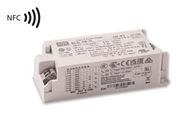
Most constant voltage LED power supplies typically have outputs of 12 V or 24 V DC, and less commonly 48 V DC (often used for LED luminaires mounted on track systems). Constant current LED power supplies often provide standard output currents of 350 mA, 700 mA, or 1050 mA. Some models also include micro-switches that allow the output current to be adjusted with a precision of 10–50 mA, while newer versions can achieve even 1 mA accuracy via NFC control.
It is extremely important to never connect a higher-voltage power supply than required to the load. If the rated power supply parameters are exceeded, there is a significant risk of overheating or burning out the load (such as an LED strip or LED module).
When selecting a power supply, it is also important to consider the overall ambient temperature.
The power reserve that should be left depending on the operating temperature is specified in the technical documentation of each power supply. If the device is expected to operate at higher ambient temperatures, this must be taken into account by providing a larger power reserve.
In the technical specifications, you can usually find a derating curve, which shows the reduction in maximum allowable power output depending on the ambient temperature.

Fig. No. 3 The maximum allowable load of a power supply depends on the ambient temperature. The graph shown in the example indicates that when operating in a +60°C environment, the maximum load must be reduced to 70% of the nominal rating. This characteristic can be found in the technical specification of the power supply.Most LED power supplies are cooled by free air convection, so it is important to ensure proper conditions for heat dissipation. Power supplies should not be mounted too close to each other; sufficient spacing must be left between them.If moisture protection is required by installing the unit in a sealed enclosure, it is recommended to choose one with thermally conductive walls. A poor solution would be mounting the power supply in a tight plastic enclosure, as plastic has poor thermal conductivity. Operating at or near maximum load under such conditions significantly shortens the power supply’s service life.
Power Supply With or Without Control?
Power supplies can be:
- Non-adjustable (fixed output) – with a fixed output voltage/current.
- Adjustable (with tuning) – where output parameters can be slightly modified using a screwdriver (typically within a 10–15% range).

Fig. No. 4 In the power supply HLG-100H-48A, both the output current and output voltage can be adjusted. MEAN WELL marks adjustable power supplies with the letter “A”, which is added after the operating voltage or current rating.
The adjustment potentiometers are covered with rubber caps to protect them from dust and moisture.

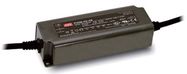
Fig. No. 5 Wirelessly controlled power supplies operating in the 2.4 GHz frequency range are managed using the CASAMBI protocol. No additional control wiring is required. Casambi Technologies uses a secure protocol in which each device in the network acts as a signal repeater, ensuring that the entire network operates stably and can bypass obstacles.
In the product model name, the designation BLE is added, for example: PWM-120-12BLE.
-
Power supplies controlled via analog signals can be regulated using 0–10V, 0–100 kΩ, or PWM. Most MEAN WELL controllable power supplies operate in analog mode and accept all three types of control signals. The length of analog control signal wiring and the number of controlled power supplies affect the output level of the power supply. Two additional wires are required for controlling these power supplies. The negative/positive output wires of the power supply must not be connected to the DIM control wires. For this type of power supply, the letter “B” is added to the model name, for example: PWM-60-24.
-
For more complex systems, it is better to use digital control protocols. Digitally controlled power supplies have DALI, DALI2, or KNX interfaces. The advantage compared to analog control is the ability to reconfigure the network according to needs. Various lighting scenarios can be created over time, the light color temperature can be adjusted depending on the time, lighting scenes can be created, and luminaires can be grouped. Diagnostic information received from the network makes it easier to operate large installations.
When selecting an LED power supply, it is necessary to consider whether protection against external influences is required.
This protection is marked as IPxx (two additional digits indicate the level of protection). The first digit (from 0 to 6) indicates protection against dust, the second digit (from 0 to 9) indicates protection against moisture. Example: IP67 means it is completely dust-tight and the power supply can be submerged in 1 meter of water for 30 minutes.
Evaluate the environmental conditions where the power supply will be installed:
- Dry room – IP20 is sufficient,
- kitchen, bathroom – IP44,
- outdoor conditions – IP65 or higher.

Pav. nr. 6 XLG-150 serijos maitinimo šaltiniai tinka montuoti lauko sąlygomis
Power supplies mounted on flammable surfaces must be marked with a symbol indicating that the temperature of the power supply will not exceed 95 °C under normal operating conditions and will not exceed 115 °C under abnormal (fault) conditions.


Pav. nr. 7 LCM-25, turi MM žymėjimą, tinka ant degių paviršių
Power Supplies with Reactive Power Compensation – for Energy Saving
If one of the main goals when installing LED lighting is energy efficiency, choose power supplies with the highest possible efficiency. Higher-end power supplies achieve efficiency levels of more than 90%. In cheaper, simpler power supplies, manufacturers do not install a PFC (Power Factor Correction) circuit, so the end user experiences higher energy losses and increased operating costs.
When a power supply is operating, both factors are important: efficiency of the power supply and power factor correction capability. The closer these values are to 1, the better the overall efficiency. When a power supply is loaded below 50%, overall efficiency starts to decrease significantly. Therefore, it is important to select a power supply so that the load is between 50% and 90% of its nominal power.
The Power Supply Must Comply with Environmental Standards
Different environments require different safety requirements. The main safety standards for LED power supplies include:
- EN61347-1
- EN 61347-2-13
- EN 62368-1
- UL8750 (for explosive environments)
Electromagnetic compatibility (EMC) standards include:
- EN55015
- EN55032 (CISPR32) Class B
- EN61000-3-2 Class C
These are only some of the basic standards that power supplies must comply with. Manufacturers that do not follow these requirements may cause operational issues for users.
LED Power Supply Grounding – Is It Necessary?
Power supplies are divided into two classes:
- Class I power supplies – have a grounding wire
- Class II power supplies – do not have grounding
Class II units usually have a plastic enclosure. If a power supply has a grounding wire, it must be connected to earth ground, as this reduces electrical noise. If metal-cased power supplies are used outdoors, it is especially important for safety reasons to properly connect the grounding wire to earth.





We have briefly reviewed all the key criteria for selecting and installing LED strip lighting and their power supplies. If you still have any questions or would like to clarify details for your project, the specialists at LEMONA electronics will be happy to help and address any remaining uncertainties.